Welcome

Showing posts with label mynotes. Show all posts

Saturday, February 5, 2022

Solid State Physics ||Unit 01 || Crystal Diffraction & Reciorocal Lattice ||💥Interference Condition & The Reciprocal Lattice 💥 || mynotes || #physicsextreem

The condition for an Xray beam to be diffracted by a crystal may be expressed in an elegant form with the help of the reciprocal lattice transformation . We have seen that Xray diffraction is equivelent to reflection by the sets of parallel lattice planes in the crystal. Since in a crystal there are many sets of interpenetrating planes with various orientation and spacings . This requires the consideration of several sets of parallel planes which is very difficult . P.P Ewald developed a simple method for this purpose. We know that orientation or slope of a plane is determined by its normal as well. Further if the length of the normal is made proportional to 1/d(hkl), its length and direction uniquely describe the set of parallel planes. Now ti determine the various sets of parallel planes we might think in terms of such one dimensional normals instead of 2 dimesional plane. Now it can be shown that the terminal points of all such possible normals corresponding to all sets of parallel planes form a lattice array . Fig(1) makes this easy for a monoclinic crystal . Here only the unit cell of the crystal are looking along its unique axis ( taken prependicular to the planes of paper and designated as b ) and the four planes (100),(101),(102),(001) are shown in an edge view.
Fig (1):---
( each point (*) reoresents completely a parallel set of planes )
 Since alk these points are parallel to b ,their normals lie in the plane of paper . To locate the points we have priceeded as followes:--
(1) :-- The normal to each plane from a common origin is drawn.
(2):-- A point on the normal at a distance from the origin equal to 1/d(hkl) has been placed.
Indeed the collection of such points form a lattice array . This array is called the reciprocal lattice, because distance in this lattice arr reciprocal to these in tge crystal.
Let us now define a reciprocal lattice vector . It is a vector whose magnitude is 1/d(hkl) and whose direction is parallel to the normal to the (hkl) planes.
The parallelopiped spanned by three non-coplanar reciprocal lattice vectors:-
is the unit cell in the reciprocal lattice.
######################
The Vector algebric analysis
######################
We shall now set up farmulae for finding the reciprocal lattice of a lattice algebrically.
Assume the primitive unit cell of volume V of the crystal lattice (fig2)
The volume V of the unit cell is equal to the area of the base (shaded), whose sides are b,c times the height of the cell, which is d(100)
Accordingly:-
An area is represented by the vector product of its sides so that it can be written as :--
here n is unit vector  in the direction of the normal to the plane (bc) . Further---
comparing eqs 1 and2, and expressing the volume in vector form ,we obtain:----
These three vectors are chosen as the reciprocal translational vectorsb, for defining the 3 dim reciprocal lattice translational vector as:----
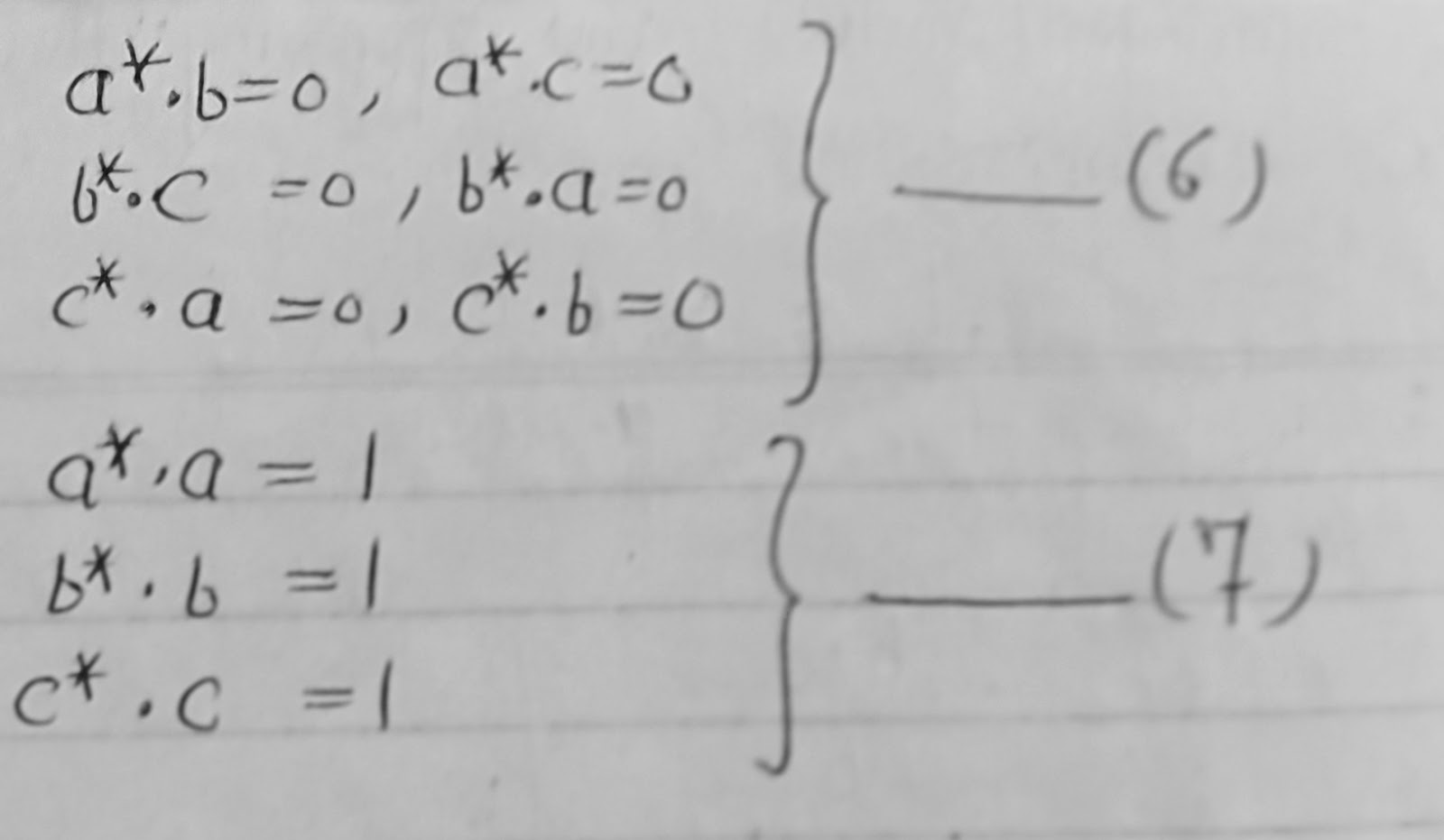
Reciprocal lattice translation vectors represent a simple relationship to the crystal translational vectors:---
or in other words:---

relation 4  can be derived by forming the scalar product of both sides of 1st relation of 4 with b,c etc. Similarly eq7 can be derived by forming the scalar product of both sides of the first eq of 4 with a etc.
If a lattice is constructed using the reciprocal lattice vector (04), it follows that successive points in the direction represent successive submultiples h of the spacing of (100), in the b* direction , successive submultiples k of the spacing of (010) and in the c* direction , successive submultiples l of the spacing of (001)
That this is indeed so, is evident from 2.
Since:--
Therefore to reach  any reciprocal lattice point hkl one gives h units along a*, k units along b*, and l units along c*.
Accordingly the reciprocal lattice vector can be written in vector notation as :---
collection of points at the terminals of the set of vectors confirms the following conditions:--
1. The vector sigma(hkl) is normal to the crystal plane (hkl) 
2. The length of the vector sigma (hkl) is equal to / d(hkl)
#######################
Proof of 1st property:--
########################
assume plane (hkl) intercepts a-axis at a/h, b-axis at b/k, c-axis at c/l.
(a/h-b/k), (-a/h+c/l), (b/k-c/l) are the vectors lying in the plane (hkl)
Consider the product as:---
Eq 10 is the. required proof.
#######################
Proof of 2nd property
########################

In view of property 1st, n unit vector normal to plane (hkl) is parallel to sigma (hkl)
Thus:---
Or we can write as;---
eq 12 proves the 2nd  condition.
Thus the reciprocal lattice spanned by eq 4 agrees with that traced out by the geometrical method.
######################
Unit cell
#######################
Volume of a unit cell of the reciprocal lattice is inversely proportional to the volume of a unit cell of the direct lattice.
Using eq 4, this becomes:--
 --------      ----------     -----------

Wednesday, February 2, 2022

Solid State Physics ||Unit 01||Crystal Diffraction & Reciprocal Lattice ||💥BRAGG'S LAW 💥||mynotes ||#physicsextreem

W.L Bragg found that position of the diffracted beams produced by a crystal can be determined by a simple model .This model assumes that xrays are reflected specularly from the various planes of atoms in the crystals. The diffracted beams are found only for special case in which the reflections from parallel planes of atoms  interfere constructively.
Xray is most useful for this purpose because its wavelength is nearly equal to (2d) {It is Bragg Condition}
We consider in the crystal a series of atomic planes which are considered to be partly reflecting for radiation of wavelength  (lambda) and which are spaced equal distance "d" apart. The radiation is incident in the plane of paper. The path difference for rays reflected from adjacent planes is 2d sin@ . 
Reinforcement of the radiation reflected from successive planes will occur when the path difference is an integral no "n" of wavelengths.
( refrence:---https://www.xtal.iqfr.csic.es/Cristalografia/parte_05_5-en.html )
This is Bragg's law.Here n being the order of diffrection .It is clear that there are only certain directions in which the reflections of a given wavelength from all parallel planes add up in phase to give a strong diffracted beam. We also reached the conclusion that a beam of monochromatic Xrays , incident on a crystal with an arbitrary angle @. 

(Ref :-- RL Singhal, C Kittel, Gupta-kumar)

Tuesday, February 1, 2022

Solid State Physics ||unit01||Crystal Diffraction & Reciprocal lattices||Diffraction of X-rays by crystals||mynotes||#extreemphysics

We require waves to explore the structure of crystals. Such waves are able to interact with ats. For this purpose its wavelength must be comparable with the interayomic spacing in crystals i.e. of the order of 1 angestrom.X ray is the  most convenient wave suitable for the study of crystals. Xrays can be diffracted by crystals just in the same way as the visible light is diffracted by a diffraction grating .Crystals can be used as diffraction grating for the diffraction of xrays.
When monochromatic beam of Xrays incidents on the atom ,harmonic vibrations of electrons begin to start. Frequency of such vibrations is equal to the frequency of the incident wave.. Due to these vibrations electrons accelerated .These accelerated electrons re-emit the radiation at the frequency of their vibration ( frequency of incident radiation)
We are concerned with  a group of atoms arranged in a regular pattern in crystals. Let a row of identical atoms are cosidered. There falls a plane xray wave normally to this group of atoms. Each atom of the row emits the radation.
The incident wave crests is assumed  to fall parallel to the row of atoms. The envelope of the wavelets emitted by individual atoms forms new wave crests and we see that besides a beam propagated in the same direction as the incident beam, there are beams in few other specific directions also. Thus althoughthe individual atoms re-emit radiation in all directions, there are only a few directions in which these wavelets reinforce eachother to produce plane waves, These waves are said to be produced by diffraction and are named as zeri order, first order, second order diffracted beams.
The problem of a row of atoms was considered only for simplcity. Actual crystals have three dimensional character. There are two ways of calculating the conditions of diffraction in actual crystals, that due to Bragg and that due to Von Lue .

Ref:-books by  RL Singhal , C.Kittel, Gupta-kumar!